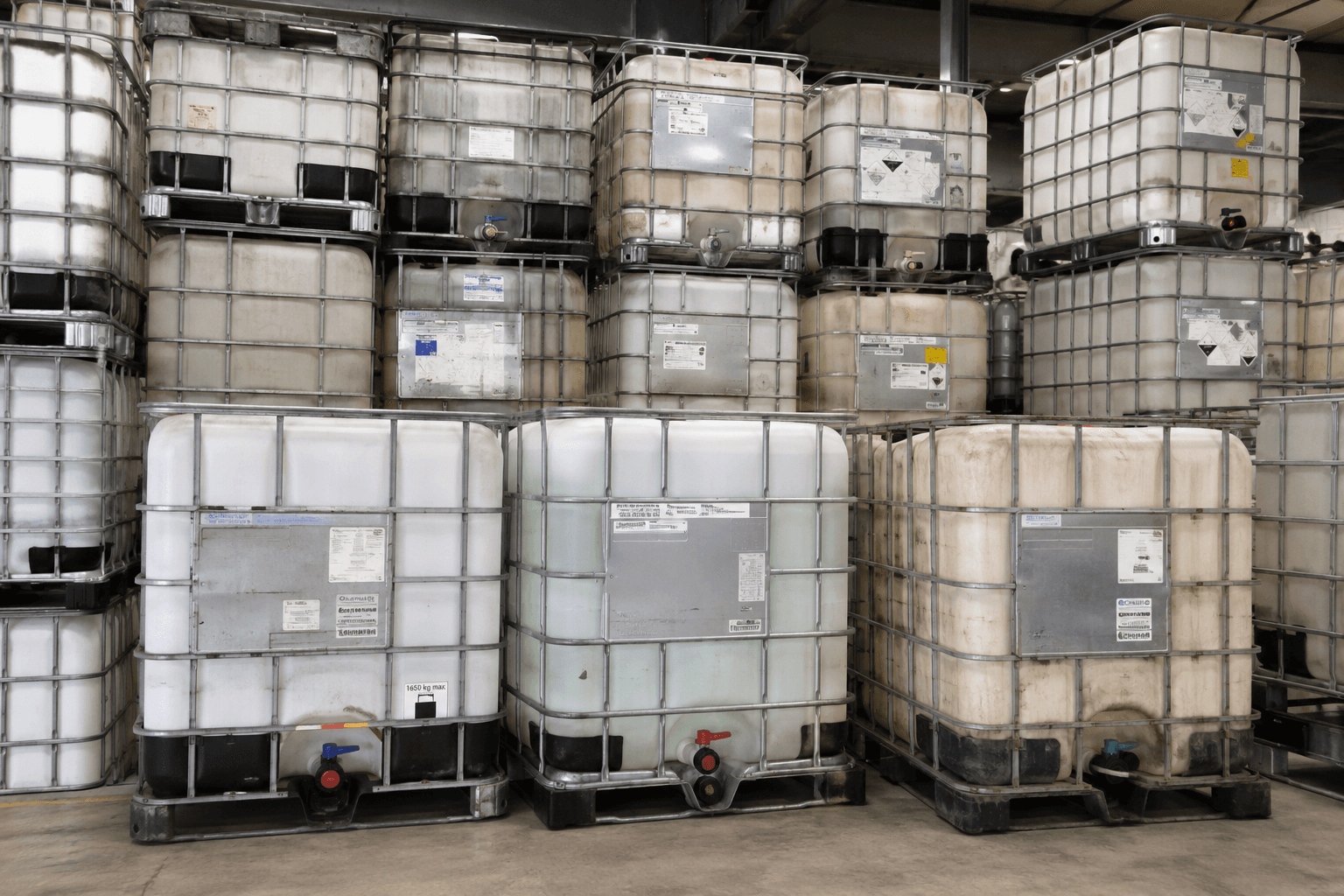
275 & 330 gallonsFood Grade
Reconditioned IBC Totes
Cleaned, pressure-tested tanks with a fresh bottle in the original cage.
Best for: Liquid storage · Non-potable water · Detergents & soaps · Fertilizers
View details →
From audit-ready food-grade tanks to garden-ready rain harvesters, here's the full catalog. Not sure which grade fits your product? The form's right here — we'll match you.
We stock reconditioned, new and food-grade 275 & 330 gallon IBC totes, replacement accessories, and upcycled goods built from retired tanks. Match the grade to your product: food-safe for anything consumable, industrial for chemicals, rinsed for landscaping and ballast.
Cleaned, pressure-tested tanks with a fresh bottle in the original cage.
Best for: Liquid storage · Non-potable water · Detergents & soaps · Fertilizers
View details →
First-use tanks for regulated, ultra-pure or export applications.
Best for: Pharmaceuticals · Ultra-pure water · Export shipments · DEF / AdBlue
View details →
FDA-compliant tanks that only ever held food-safe products.
Best for: Beverage & brewing · Edible oils · Maple & syrups · Rainwater harvesting
View details →
Valves, adapters, caps, lids, heaters and fittings to keep totes in service.
Best for: Repairs · Custom dispensing · Winterizing · Retrofits
View details →
Rain harvesters, planters, compost systems and hydroponic rigs built from retired totes.
Best for: Rain harvesting · Community gardens · Homesteads · Education
View details →
IBC totes come in four common sizes. The 275 and 330 gallon tanks share the same 40 × 48-inch footprint — critical if you're planning rack storage or tight dock clearances.
| Size | Footprint | Typical Use | Weight Empty | Notes |
|---|---|---|---|---|
| 110 gal | 24×24 in pallet | Decant & lab | ~30 lbs | Great for tight spaces; pairs with 275/330 for overflow |
| 275 gal | 40×48 in pallet | All-purpose workhorse | ~130 lbs | The most common size; fits most dock doors |
| 330 gal | 40×48 in pallet | High-volume storage | ~145 lbs | Extra 55 gal capacity, same footprint as 275 |
| 550 gal | 40×48 in pallet | Bulk buffer tank | ~180 lbs | For large-scale ag and process lines; ask about availability |
* 110 and 550 gal available on request. Lead times vary — email us your volume and timeline.
"Reconditioned" is a documented process — not a rinse and a hope. Here's exactly what happens to every tank before it leaves our yard.
Every incoming tank is logged with its prior-contents history before it goes anywhere else. No tank moves without a record — that traceability is the foundation of every grade we assign.
We review the product history against the intended next use. Food-safe? Chemical-compatible? Needs rebottling? The answer shapes everything that follows.
Compatible bottles get a hot-water triple-wash that reaches every corner of the interior. When contamination demands a fresh start, a new food-safe or industrial bottle drops into the reclaimed cage.
We check every weld, tube and crossmember of the steel cage and every forklift entry point on the pallet. A sound structure is as important as a clean bottle.
Every assembled unit is pressurized and tested before the valve is fitted. Passes get tagged. Anything that doesn't is pulled for re-work — no exceptions.
The finished tank leaves with a traceable grade tag showing prior contents, wash cycle and grade. You know exactly what you're getting, and so do your auditors.
Liquid fertilizer, herbicides and crop inputs stored and transferred safely by the tote — from the supplier to the field edge.
Brewing water, wort, spirits and rinse liquids in documented food-grade tanks that can pass any TTB or state inspection.
Buffer tanks between production steps, chemical storage and process-line transfer — stackable, forkliftable and graded to spec.
Detergents, degreasers and sanitizing concentrates stored and dispensed in bulk, with compatible prior-history documentation.
Non-potable process water, treatment chemicals and ballast for utilities and public-works projects across Illinois.
Fertilizers, pesticides and irrigation water stored at the field edge — and hauled back when the season ends for reconditioning.
Dust suppression, curing water, concrete admixtures and equipment coolants kept on site in tanks that move with the project.
Ingredients, syrups, oils and bulk-liquid inputs moved between facilities in documented, audit-ready tanks.
Rain collection, grey-water storage and gravity-fed irrigation for anyone who wants to get off the municipal grid.
Triple-rinsed, sold as-is. Great for landscaping, ballast and dust control where trace residue is irrelevant.
Held non-food chemicals, cleaned for compatible reuse. The workhorse for detergents, coolants and compatible chemistry.
Only ever held FDA-recognized food-safe products; sanitized and documented for anything consumable.
A brand-new bottle in a reclaimed cage — an effectively new interior at a reused price.
Never held product. For pharma, ultra-pure or export applications that require a virgin container.
A new IBC tote requires roughly 60 lbs of virgin steel for the cage, another 40 lbs of HDPE for the bottle, and a fresh composite or steel pallet underneath. Manufacturing all that from raw materials emits a significant amount of CO₂ before the tank ever holds a drop of liquid. A reconditioned tote reuses the steel cage and pallet indefinitely — the two heaviest, most carbon-intensive components — and only replaces the bottle when contamination demands it. The result is roughly 90 lbs of material kept in service, a fraction of the embodied carbon, and a delivered price about half that of new. That's not a compromise. That's just the smarter math — for your budget and the planet.
Butterfly, ball, camlock, NPT — matched to your line pressure and liquid. EPDM for food and water, Viton for solvents and acids.
Vented for gravity drain, solid for transport, tamper-evident for regulated cargo. The right cap turns a plain tote into the right tool.
Wrap-around jackets and band heaters for viscous or freeze-sensitive liquids — thermostatically controlled, full-coverage.
Reclaimed galvanized frames and composite pallets to rebuild a tank instead of scrapping it. The greenest part swap in the catalog.
Send those six points to us by email and we'll come back with a graded, priced quote within one business day — in writing, with every number tracked. No phone tag, no verbal estimates that evaporate. Just a clear answer so you can make a decision and move on.
Mixed grades? Tight timeline? Truckload pricing? Put it all in one email. We'll address every line item, suggest the right grade if you're unsure, and spec the adapter or seal if you need it. The whole process runs on email because it keeps a clean record for both sides.
Get a same-week quote to buy, sell, recondition, ship or recycle IBC totes across the Midwest.