01
Find the cage label
Usually a riveted steel or embossed plate on one of the upright cage tubes, or a UV-resistant sticker on the frame. It carries the UN marking, max gross mass, manufacture year, and reconditioning history (if applicable).
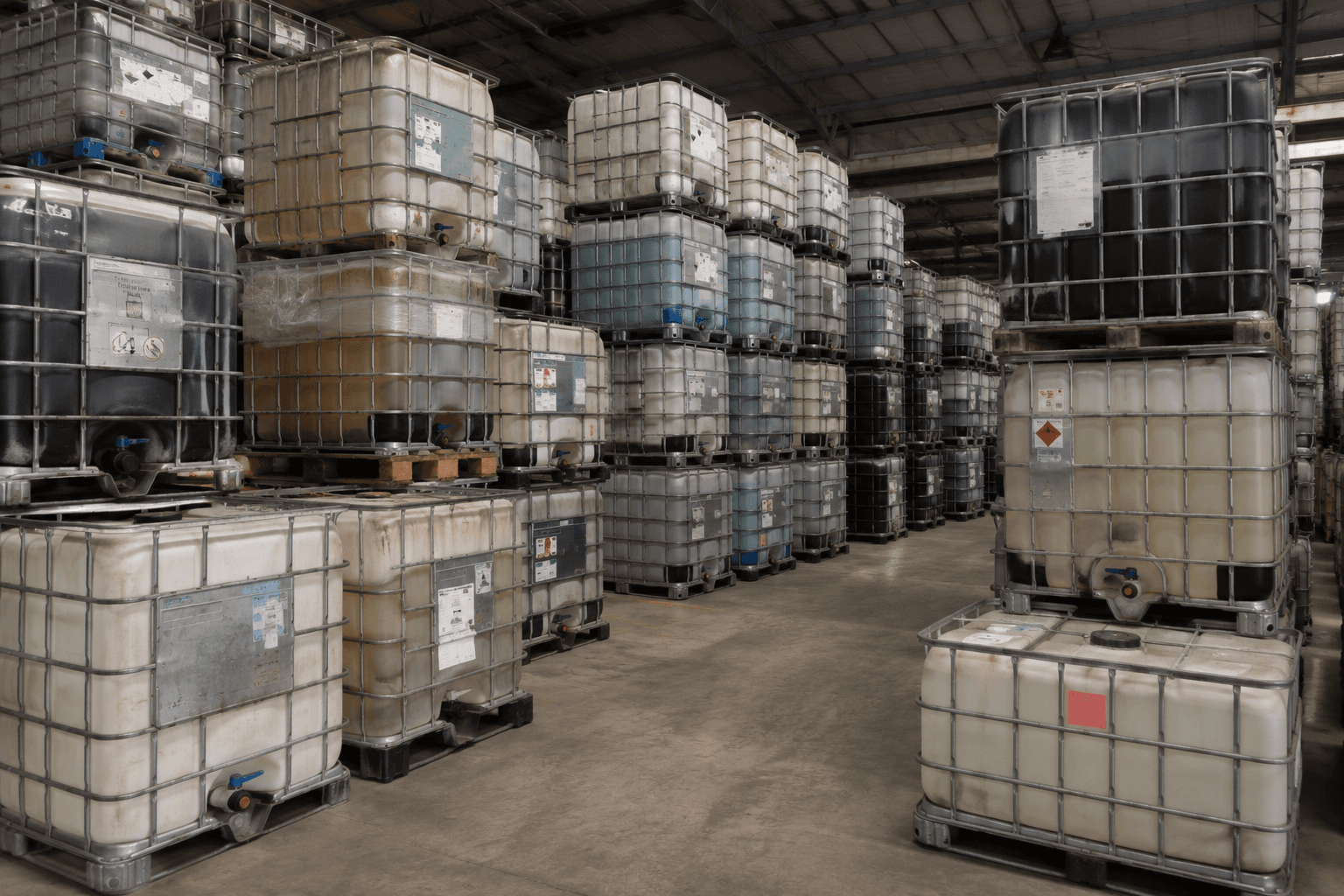
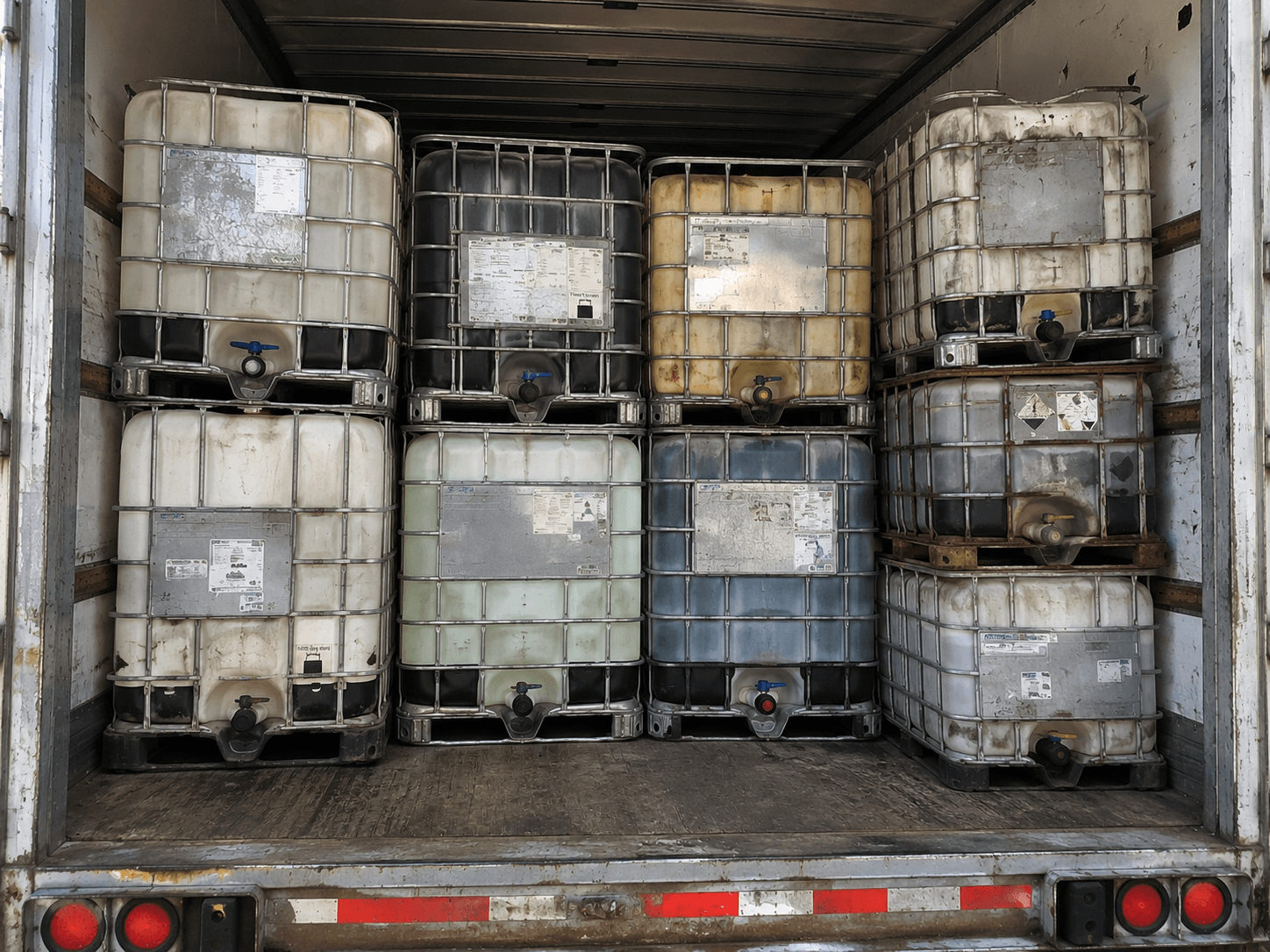
Ordering totes is easy once you know three numbers: volume per batch, your door and forklift clearances, and the fittings your equipment expects. This guide covers all three, in exhaustive detail.
Most North American IBC totes are 275 or 330 gallons on a 40 × 48 in pallet, roughly 46–53 in tall. The 275 is the default; step up to 330 for more volume in the same footprint, or down to 110 for tight spaces. Match the S60x6 outlet to a camlock, hose or NPT adapter for your equipment.
All sizes share the same S60x6 outlet thread and 2-inch standard valve. Pallet footprint and height are the practical differentiators — measure your door, dock and rack clearances before ordering.
| Size | Volume | Dimensions (L×W×H) | Empty | Full (water) | Notes |
|---|---|---|---|---|---|
| 275 Gallon IBC | 275 gal / 1,040 L | 48 × 40 × 46 in | ~130 lbs | ~2,400 lbs (water) | Most common size in North America |
| 330 Gallon IBC | 330 gal / 1,250 L | 48 × 40 × 53 in | ~150 lbs | ~2,900 lbs (water) | Taller bottle, same footprint |
| 110 Gallon IBC | 110 gal / 420 L | 40 × 32 × 40 in | ~90 lbs | ~1,000 lbs (water) | Tight spaces & smaller batches |
| 550 Gallon IBC | 550 gal / 2,080 L | 50 × 46 × 72 in | ~240 lbs | ~4,800 lbs (water) | High-volume single-fill |
| 660 Gallon IBC | 660 gal / 2,500 L | 53 × 46 × 83 in | ~300 lbs | ~5,800 lbs (water) | Industrial bulk liquid, rare in Midwest |
| 275 Gal — Rebottled | 275 gal / 1,040 L | 48 × 40 × 46 in | ~135 lbs | ~2,400 lbs (water) | New HDPE bottle in a reclaimed cage |
Dimensions and weights are typical values. Actual specs vary by manufacturer ±1–2 in on height and ±5 lbs on empty weight. Always verify with the cage label before purchasing racks or shelving.
Small-batch, tight spaces
Choose when: Your batch size is under 100 gallons, you have low ceilings or narrow aisles, or you need a portable unit that a single-axle truck can handle.
Skip when: High-volume operations — the per-gallon cost is much higher and the handling overhead adds up fast.
The Midwestern workhorse
Choose when: Standard dock-height forklifts, normal 8-ft ceiling clearance, agricultural and industrial chemical applications, food and beverage storage, rainwater collection.
Skip when: When you need maximum volume per pallet slot and you have clearance for the extra 7 inches of the 330.
Max volume, same footprint
Choose when: You have ≥54 in of vertical clearance at your dock, truck or storage area. Saves on number of moves per production run. Same freight cost per tote as 275.
Skip when: Low ceilings, older warehouses with low-clearance racking, or any situation where the extra 7-inch height creates a safety or handling risk.
High-volume single-fill
Choose when: Large single-fill operations, bulk liquid storage where floor space is at a premium. Requires a heavy-duty forklift (the full tote exceeds 4,800 lbs) and reinforced flooring.
Skip when: Frequent movement — these are heavy, tall and need specialty handling equipment. Better as stationary or semi-permanent storage.
The outlet is where product meets process. Choose the right valve for your flow rate, product viscosity and downstream fittings — it matters more than most buyers realize.
| Outlet | Use | Adapts to |
|---|---|---|
| S60x6 buttress | Universal outlet thread on virtually all IBCs | Camlock, 3/4 in garden hose, NPT, DIN flange |
| 2 in butterfly valve | Controlled gravity dispensing, most common | Camlock A/B, NPT male, S60x6 |
| 2 in ball valve | Full-flow shutoff; preferred for viscous products | Camlock, threaded, NPT |
| 3 in valve | High-flow transfer for thick or granular material | Large camlock, DIN flange |
| 3/4 in NPT port | Secondary sampling or pressure-relief tap | NPT male fittings |
| Camlock (Type C) | Quick-disconnect hose coupling, pump-out | Camlock B, D, E or suction hose |
The 6-inch fill cap at the top is your access point for filling, cleaning and inspecting. Vented caps prevent vacuum lock during gravity drain; solid caps seal tightly for pumped systems.
| Cap | Use |
|---|---|
| 6 in vented cap | Gravity draining without vacuum lock — most common |
| 6 in solid cap | Sealed storage & pumping; use with dip tube or pump |
| 6 in tamper-evident | Food, pharma & regulated shipping; shows if opened |
| 9 in cap | Older or large-neck bottles; less common post-2005 |
| 150 mm fill cap | Metric equivalent of 6 in; common on European-origin totes |
| Pressure-rated cap | Maintains up to 0.5 bar for certain chemical grades; check stamp |
The S60x6 buttress thread is the universal adapter platform for IBC totes. These off-the-shelf adapters cover the vast majority of process connections.
S60x6 outlet
Connect to standard pipe fittings
S60x6 outlet
Connect to camlock hoses — most common pump connection
S60x6 outlet
Gravity draining with a standard hose
S60x6 outlet
Food/beverage and pharma pumping systems
S60x6 outlet
European process connections
2 in butterfly valve
Direct pump attachment, most common in agricultural use
A standard IBC tote has five distinct material zones — each with its own service life, compatibility profile and recyclability. Understanding them helps you spec the right tote and maintain it correctly.
Blow-molded high-density polyethylene; translucent for level checks; rated for most food, ag-chem and water applications. Resin code 2.
Tubular grid that carries the structural load and protects the bottle. Can be reused indefinitely with inspection. Zinc coating resists rust; look for white oxidation, not red rust.
Wood/plastic/steel base with 4-way forklift entry. Inspect for cracked corner blocks before stacking.
Used on 550 and 660-gallon IBCs and some specialty units; significantly heavier than composite but indefinitely reusable.
Ethylene propylene diene monomer; best for water, mild acids, and most food-grade products. The default seal on most reconditioned totes.
Fluoroelastomer for aggressive solvents, acids, petroleum products and elevated temperatures up to 400°F. Specify at order time for chemical service.
Used on butterfly valves and adapters. Chemically resistant to most acids and bases but avoid strong oxidizers and aromatic solvents.
HDPE is compatible with most water-based solutions, organic acids, alcohols, alkalis and many polar solvents. It is NOT suitable for aromatic hydrocarbons (toluene, xylene), strong oxidizers (concentrated H₂O₂, fuming nitric acid), or chlorinated solvents (methylene chloride). Always check an HDPE chemical compatibility chart for your specific product before filling. Viton® seals extend the tote's chemical range — but they don't change the bottle material.
IBC stacking incidents are among the most preventable warehouse accidents. The rules are simple — follow them every time.
| Configuration | Max stack | Critical note |
|---|---|---|
| Single empty tote | 2 high (empty) | Never stack filled IBCs without confirmed rated rack or cage. |
| Filled tote on rack | 1 high (floor level) | Ground-level only unless rack is rated for the gross weight. |
| Racked storage, rated cage | Per rack SWL | Verify cage label for stacking load rating (typically 4,400 lbs SWL). |
Safe working load (SWL) is stamped on the cage label — typically 4,400 lbs for standard units. That rating applies to the cage structure, not your floor or rack. Verify both.
A full 330-gallon tote weighs ~2,900 lbs. With pallet and cage you're at ~3,050 lbs. Most standard 5,000-lb forklifts handle this fine at rated center of gravity — but confirm with your forklift spec sheet.
A filled 275-gallon tote on a composite pallet concentrates ~2,400 lbs on a 40 × 48 in footprint — about 15 psi. Most industrial concrete floors handle this; check with your building engineer for older structures.
The UN performance mark is your safety passport for regulated shipping. Every code means something specific — here's the decoder. A mark of "31HA1/Y/2024/USA" is the most common you'll see on a reconditioned IBC.
| Mark / Code | Meaning |
|---|---|
| 31HA1 | Composite IBC — HDPE bottle in steel cage — liquid service |
| 31HZ1 | Composite IBC — HDPE bottle in non-metallic (plastic) cage |
| Y | Packing group II — medium-hazard liquids |
| Z | Packing group III — low-hazard liquids |
| X | Packing group I — high-hazard liquids (less common for IBCs) |
| 2025 | Manufacture year (4-digit) |
| USA / UN | Country of approval and UN type approval body |
Intact mark = valid certification
As long as the UN mark is stamped on the cage (not a sticker) and no structural repairs have been made that weren't re-certified, the original approval remains valid.
Worn or missing mark = decommission for transport
If the mark is unreadable, do not use the tote for regulated freight. It may still be usable for in-plant storage of non-regulated liquids.
Packing group matters
Y-rated totes cover PG II and III. If your product is PG I (highest hazard), you need an X-rated tote — much less common. Check your SDS for packing group.
Reconditioning resets the date
When a tote is reconditioned by a certified facility, a new reconditioning code and date is added to the cage label. This extends the regulatory service life for transport.
The date is manufacture, not expiry
The 4-digit year on the UN mark is the year of manufacture. It does not indicate when the tote must be retired — that depends on condition and reconditioning history.
Inherited a tote with no documentation? Follow these six steps and you'll know what you have, what it held, and whether it's safe for your intended use.
Usually a riveted steel or embossed plate on one of the upright cage tubes, or a UV-resistant sticker on the frame. It carries the UN marking, max gross mass, manufacture year, and reconditioning history (if applicable).
From the top of the pallet to the base of the fill cap, with the cap removed. 40 in = 110 gal; 46 in = 275 gal; 53 in = 330 gal; 72 in = 550 gal. Heights can vary ±1 in by manufacturer.
Standard is 40 × 48 in. Compact 110-gallon units are often 32 × 40 in. Measure the pallet, not the cage — the cage usually overhangs slightly.
Most IBCs use S60x6 (60 mm, 6 mm pitch buttress). Count the thread turns on the existing valve — 6 full turns indicates S60x6. Non-standard threads are rare but exist on some European-origin totes.
Natural/translucent = standard HDPE. White = UV-stabilized, often food-grade. Black = UV-blocking, typically industrial. Blue tints sometimes indicate drinking water service. Color alone does not confirm grade.
Previous owners often stencil or label totes with product name, lot number, or facility code. These give clues to prior contents. Cross-check with the cage label dates to establish history.
Email us photos of the cage label, all four sides of the bottle, the outlet valve, and the interior (shine a flashlight through the wall). We'll give you a grade assessment within one business day — at no charge.
Two 275-gallon totes sitting side by side can be indistinguishable by sight. One previously held apple juice; the other held industrial cleaner. The only way to know is documentation — and that's exactly what our reconditioning records provide.
Food-grade prior contents
Juices, syrups, oils, vinegar, food-grade ethanol, water
Industrial prior contents
Detergents, lubricants, fertilizers, herbicides, acids, bases
Rinsed / Field grade
Mixed or unknown; cleaned but not documented
Myth: "All 275-gallon totes are the same."
Reality: Dimensions vary slightly by manufacturer — some run 47 in tall, others 45 in. Always measure before committing to a tight shelf or rack. The pallet footprint (40 × 48 in) is highly consistent, but cage tube diameter, top frame height and corner fitting style differ.
Myth: "You can stack filled totes freely."
Reality: Never stack filled IBCs on top of one another without a rated rack. The cage SWL rating is for empty stacking only. A filled 275-gallon tote weighs 2,400 lbs — that's 1.2 tons on the bottle cap and cage top rails if you stack a second one above it.
Myth: "The 6-inch opening is the fill opening."
Reality: The 6-inch cap is both the fill port and the main access opening. Vented caps allow gravity draining; solid caps are for pumped systems. The 2-inch outlet valve at the bottom is the drain/dispense point.
Myth: "HDPE totes are fully opaque so you can't see the fill level."
Reality: Natural HDPE is translucent — in good lighting you can see the liquid level through the bottle wall. Colored or UV-stabilized bottles (white or black) are less transparent. If you need level visibility, choose natural-colored HDPE or add an external sight gauge.
Myth: "A tote that smells clean is food-grade."
Reality: Odor is necessary but not sufficient for food-grade certification. A tote that held a fragranced cleaning product may smell pleasant but is not food-grade. You need documented prior contents and a formal reconditioning record, not just a sniff test.
Myth: "1,000-litre IBCs and 275-gallon IBCs are the same thing."
Reality: 275 gallons is 1,040 litres — close but not exactly 1,000 L. Most 275-gallon totes are rated to at least 1,000 L and the difference is negligible for most applications. For EU export or metric-certification purposes, confirm the exact rated volume on the tote label.
For most storage and non-regulated liquids, reconditioned totes are the smart choice: about half the price and a fraction of the carbon of new. Choose new only when regulation, ultra-purity or export documentation demands a first-use tank.
Read · 6 min →
ReferenceIBC tote grades describe a tank’s history and preparation. Food grade held only food-safe products; rebottled has a brand-new bottle in a reused cage; industrial held non-food chemicals; rinsed is cleaned but ungraded. Match the grade to your product and your paperwork needs.
Read · 5 min →
Buying GuidesPick your tote size from three things: the volume you move per batch, the door and forklift clearances at your site, and the valve/cap fittings your equipment expects. For most users a 275 or 330 gallon tote on a 40×48 in pallet is the sweet spot.
Read · 7 min →
SustainabilityReusing IBC totes is one of the highest-leverage packaging decisions a business can make. Each reused tank keeps roughly 90 lbs of steel and plastic in service, avoids virgin manufacturing emissions, and can be tracked for Scope 3 reporting.
Read · 8 min →
LogisticsIBC tote freight cost is driven by shipment size, lane distance and mode: LTL rates per tote run high for small orders while full truckloads (around 40 totes) spread the base haul cost efficiently. Illinois buyers who source locally cut freight costs significantly compared to national drop-ship programs.
Read · 6 min →
Buying GuidesInspect a used IBC tote in five zones: cage (corrosion, bent tubes, weld cracks), bottle (stress cracks, discoloration, odor), valve (leaks, thread damage, smooth operation), pallet (rot, missing boards, forklift entry), and paperwork (prior contents, wash record, grade tag). Walk away from any tote missing documentation or showing structural damage.
Read · 5 min →
ApplicationsFood-grade IBC totes are well-suited to rural fire suppression and emergency water storage: one 275-gallon tank provides about 275 gallons of reserve at gravity pressure, and multiple linked totes scale to farm or community needs. Use only food-grade tanks for potable reserves, size by gallons-per-minute demand, and check local fire code for required capacities.
Read · 7 min →
SustainabilityFollow the hierarchy: reuse first, upcycle second, recycle last. When a tote genuinely cannot be returned to liquid service or upcycled, separate the steel cage for scrap metal recycling and recycle the HDPE bottle through an industrial plastics recycler. IBC Solutions Illinois accepts end-of-life units for responsible disassembly and recovery.
Read · 6 min →
Get a same-week quote to buy, sell, recondition, ship or recycle IBC totes across the Midwest.