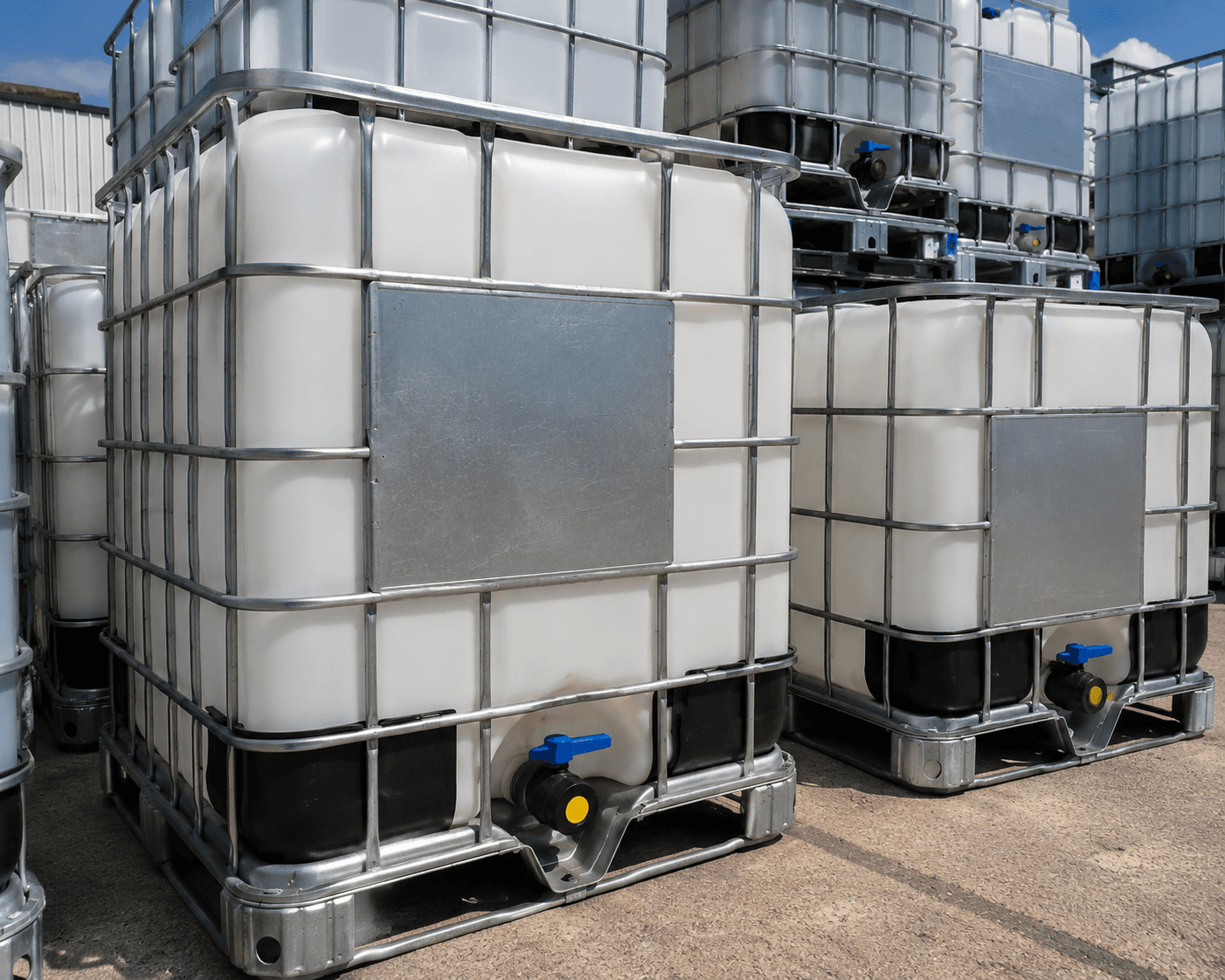
Local Pickup — Peoria, IL
Pick up from our yard — email ahead to schedule loading. Bring your own truck, straps and blocks. We help load with the forklift.
FDA-compliant tanks that only ever held food-safe products.
Food-grade IBC totes have only ever contained FDA-recognized food-safe products such as syrups, oils, juices or vinegar. We verify the prior-contents history, sanitize the bottle and tag each unit so you can trust what touched your product.
Eco note: Reusing a food-grade tank for rainwater or brewing is one of the highest-value second lives an IBC can have.
Food-grade IBC totes have only ever contained FDA-recognized food-safe products — syrups, edible oils, juices, vinegar and the like — and they come with the two things that actually define the grade: a verified prior-contents history and a record of the sanitizing done to prepare them. You are not just buying a tank; you are buying documentation you can hand to your own auditors.
Small producers love these tanks: brewers, distillers, cideries, hot-sauce makers, maple and honey producers, urban farms and rainwater harvesters all get the price of reuse with the safety of paperwork. When a tank cannot be brought to standard by washing alone, we rebottle it — a brand-new bottle in the reclaimed cage — so the interior is effectively new.
| Capacity | 275 & 330 gallons |
|---|---|
| Cage & pallet | Reclaimed or new steel cage, food-safe bottle |
| Volume | 275 gal / 330 gal |
| Prior contents | Food-safe only, verified |
| Bottle | Natural HDPE, FDA 21 CFR 177.1520 |
| Valve | 2 in food-grade EPDM seal |
| Sanitizing | Hot wash + food-safe rinse |
| Available grades | Food Grade Reconditioned, Virgin Food Grade |
The difference between a food-grade tote and an industrial one is documentation. We keep a chain-of-custody record for the prior product, the wash cycle and the seal replacement, so brewers, distillers and growers can pass their own audits.
Cideries, hot-sauce makers, urban farms and rainwater collectors love food-grade reconditioned totes: the price of reuse, the safety of documentation, and a story their customers respect.
| Outlet thread | 2 in S60x6 coarse buttress — the universal IBC standard |
|---|---|
| Butterfly valve | Standard on most reconditioned tanks; 1/4-turn open/close |
| Ball valve | Higher-cycle alternative; stainless or polypropylene body |
| Camlock (Type C/E) | S60x6 → camlock for fast-connect filling and dispensing |
| Garden hose | S60x6 → 3/4 in GHT, male or female, for gravity dispensing |
| NPT | S60x6 → 1 in or 2 in NPT for pump suction and fixed-pipe connections |
| Seal — EPDM | For water, food products and mild chemistry; food-grade default |
| Seal — Viton | For solvents, fuels and aggressive acids; specify at order |
| 6 in vented cap | Allows gravity drain without vacuum lock — the go-to for open dispensing |
|---|---|
| 6 in solid cap | For pressurized, transported or sealed-fermentation applications |
| Tamper-evident | Security strip required for regulated or export cargo |
| Breather vent | For tall-neck or closed-loop setups where pressure equalization matters |
Need a different adapter or specialty valve? Browse all accessories →
| Standard outlet | 2 in butterfly valve with food-grade EPDM seal |
|---|---|
| Sanitary ball valve | Tri-clamp or S60x6 stainless ball valve for CIP compatibility |
| Garden-hose adapter | S60x6 → 3/4 in GHT for small-scale dispensing |
| Lid – vented | 6 in food-safe vented cap |
| Lid – solid | 6 in solid cap for sealed fermentation or transport |
| Seal – EPDM only | Food-grade EPDM; Viton not recommended for food contact |
Pick up from our yard — email ahead to schedule loading. Bring your own truck, straps and blocks. We help load with the forklift.
We palletize and band for standard 96/102-inch LTL trailers across Illinois and the Midwest. Standard lead time 3–5 business days. We prepare the BOL.
40 totes fit a standard 48-ft dry van in two rows of 20. Our best per-unit rate. We schedule to your dock on your timeline.
Hundreds of gallons of clean brewing or rinse water on hand, dispensed through a sanitary valve.
Oils, syrups, juices and vinegars stored and transported in a documented, food-safe tank.
Ship syrup, honey or sauce by the tote to packers and wholesalers instead of one jar at a time.
A food-grade tank is the safe base for edible-garden rain capture and aquaponics.
| 31 | IBC container type per UN standards |
|---|---|
| H | Plastic (HDPE) inner receptacle |
| A | Rigid outer body (steel cage) |
| 1 | Free-standing (no outer packaging needed) |
| Y | Packing group II — medium-danger liquids |
| 275L | Maximum gross mass or capacity in liters |
Just ask in your order email — no extra cost for documentation.
We confirm the tank only ever held FDA-recognized food-safe products before it qualifies as food-grade.
A hot wash and food-safe rinse, with attention to the valve, cap threads and outlet passages where biofilm hides.
If the interior cannot be brought to standard, a brand-new food-safe bottle goes into the reclaimed cage.
Prior contents, wash record and grade tag travel with the tank so your chain of custody is intact.
Use it. Return it. Repeat it.
Every empty you send back to us is a cage and pallet that stays in service, a bottle that gets a new life, and a step that keeps material out of the landfill. The loop only closes if everyone closes it.
Get a same-week quote to buy, sell, recondition, ship or recycle IBC totes across the Midwest.