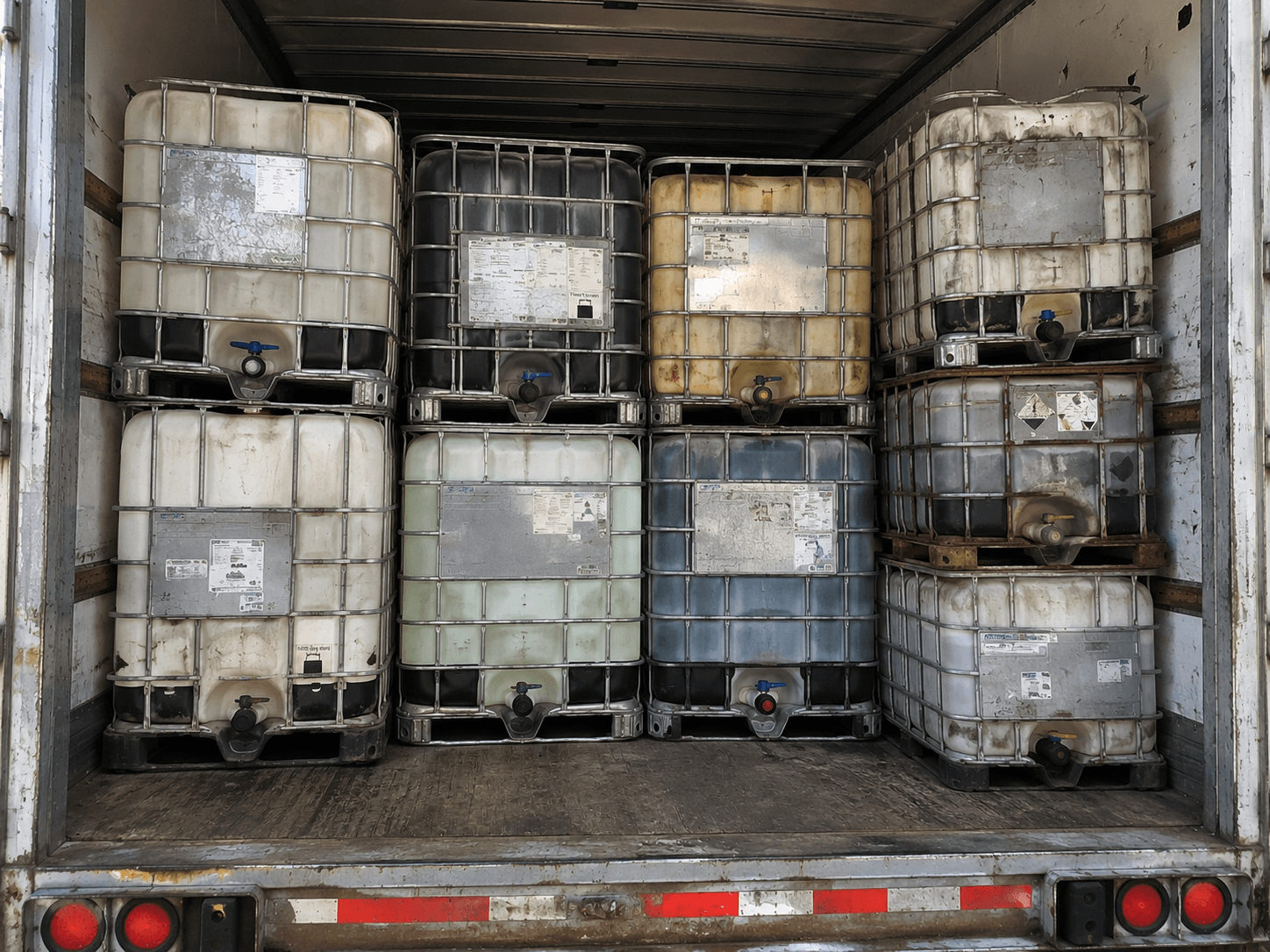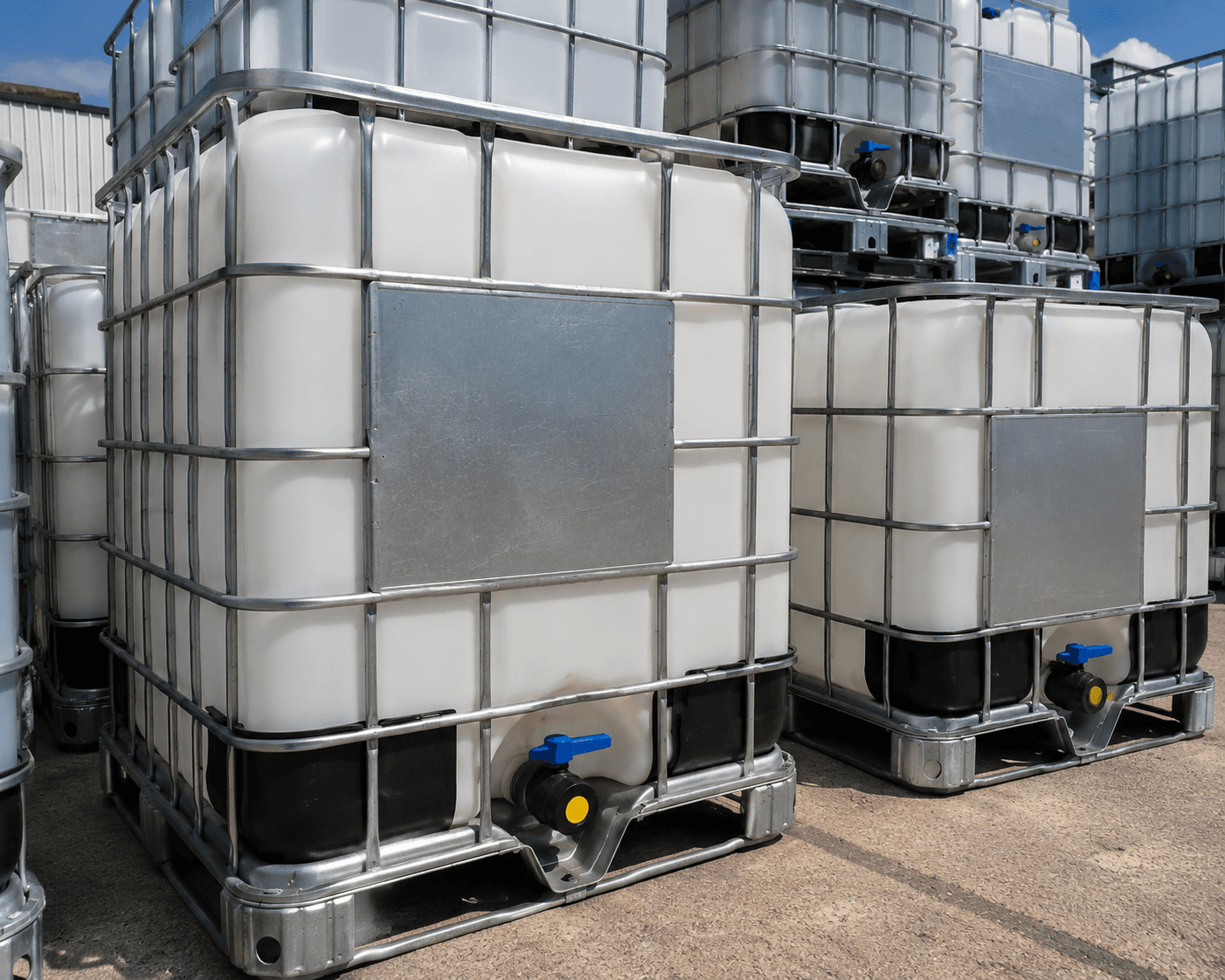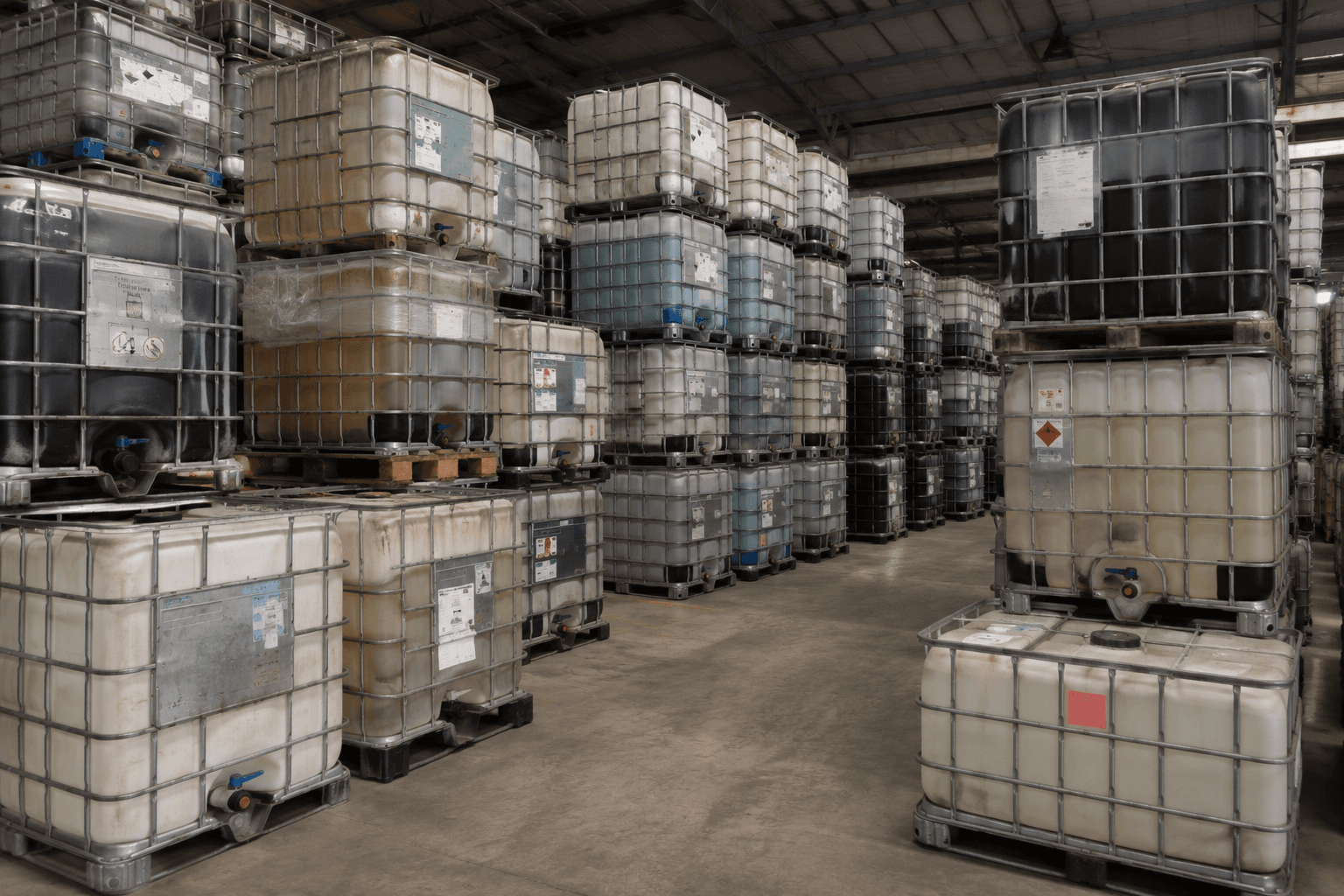
Recycling still burns energy
Remelting steel and reprocessing HDPE into pellets requires significant heat and energy. Reuse skips that step entirely — the cage goes back to work as a cage, not as a furnace charge.
We’re a little obsessed with keeping tanks high on the waste hierarchy. This page shows exactly why reconditioning a tote crushes the footprint of building a new one.
Reusing an IBC tote avoids roughly 90 lbs of new steel and plastic and the full energy of manufacturing a virgin tank — every single time. Recycling is good, but it still burns energy to reprocess; reuse skips that entirely, which is why it sits at the very top of our ladder.
Reduce → Reuse → Recondition → Recover → (never) Landfill.
new steel kept in service
virgin HDPE avoided
CO₂e emissions avoided
process water saved
Figures are conservative per-tote averages drawn from typical IBC life-cycle data, offered for guidance. We provide documented, fleet-specific numbers on request.
CO₂e avoided
Steel reused
Virgin plastic avoided
Process water saved
That’s roughly the yearly CO₂ absorption of 44 trees. Estimates are conservative per-tote averages for guidance, not a certified audit — ask us for documented figures for your fleet.
"Recycle" sounds responsible. "Reuse" is better. The gap between them isn’t a branding choice — it’s physics, energy and lifecycle analysis.
Remelting steel and reprocessing HDPE into pellets requires significant heat and energy. Reuse skips that step entirely — the cage goes back to work as a cage, not as a furnace charge.
Reuse has sat at rung two of the EPA and EU waste hierarchy for decades because lifecycle analysis consistently shows it outperforms recycling on carbon, energy and water metrics.
Every kWh that went into mining, refining and shaping the original steel cage is preserved when that cage is reused. Recycling recovers ~60–80% of that energy at best; reuse recovers 100%.
A cage that does 10 reuse cycles before going to metal recovery avoids 9 rounds of new-steel production. The savings multiply with every trip.
Switching from new to reconditioned totes directly reduces your Scope 3 Category 1 (purchased goods) emissions — a number that increasingly appears in ESG disclosures and procurement RFPs.
The carbon and resource differences happen at every stage of the lifecycle — not just at end of life. Here’s the honest comparison.
| Lifecycle stage | New tote | Reconditioned | Why it matters |
|---|---|---|---|
| Virgin manufacture | Full: ore → steel, crude oil → HDPE pellets → molding → assembly | Skipped almost entirely. No new ore, no new crude for the cage. | Reconditioning avoids the two most carbon-intensive manufacturing steps. |
| Transport to yard | Factory (often overseas or distant domestic) → distribution → you | Short-haul from regional user to our Peoria yard and back | Low-mile backhaul routes dramatically cut freight emissions. |
| Processing energy | High energy: smelting, injection molding, painting, assembly | Modest energy: hot-water wash, inspection, pressure test | Wash energy is a small fraction of manufacturing energy — typically 5–10×. |
| Water use | ~130+ gallons process water in manufacture | Wash uses water, but closed-loop systems recover & recycle most of it | Net water avoided is estimated at ~130 gallons per reuse cycle. |
| End of life | Eventually landfill or delayed recovery — often buyer's problem | Material recovery built-in: HDPE regrind, steel to scrap, pallet repair | Zero-landfill pipeline means nothing is someone else's problem. |
An IBC tote is three distinct material streams: steel, HDPE and a pallet. Each has its own highest-and-best reuse path, and we track all three.
Recovery path: Reused directly in reconditioned unit; eventually to metal recovery
Vs. virgin: ~60 lbs new steel avoided per reuse cycle
~55 lbs CO₂e avoided (steel production is extremely carbon-intensive)
Recovery path: Washed and reused; or replaced and HDPE reground into pellets
Vs. virgin: ~35 lbs virgin plastic avoided when bottle is reused
~25 lbs CO₂e avoided (vs. molding a new HDPE bottle)
Recovery path: Repaired and kept in service; chipped for mulch or fiber board when spent
Vs. virgin: Extends pallet life by 3–5 cycles before material recovery
Minor but measurable — avoids new pallet manufacture
Recovery path: Replaced with compatible parts; old valves reground or metal-recovered
Vs. virgin: Accessory replacement avoids whole-tote disposal
Negligible weight but high leverage — a $12 valve saves a 100-lb tank
Every tote we receive passes through a decision sequence designed to extract maximum value before any material goes to recovery — let alone disposal.
Every incoming tote is evaluated first for reuse — can the bottle, cage and pallet all continue in service? This is always the goal.
If the unit needs work but the structure is sound, it enters our triple-wash and inspection line. Most totes qualify.
If only the inner bottle has reached end of reuse, we swap it for fresh HDPE and put the cage back to work. The heaviest part never leaves the loop.
Tanks that can no longer hold industrial liquids become rain harvesters, planters or compost systems. One more decade of useful service before any material is processed.
When a bottle truly can't continue, we clean and regrind it into HDPE pellets — a commodity with active end markets in durable goods manufacturing.
Cages go to certified metal recovery. Wood pallets are chipped for fiber products or repaired for continued use. Composite pallets are material-separated.
The circular economy framework is simple: eliminate waste by keeping products and materials in use at their highest value for as long as possible. Here’s how that maps to everything we do.
IBC totes are already engineered for multi-cycle use. The steel cage is designed to outlast dozens of bottle swaps. We keep both in service as long as physically possible.
Every reconditioned sale keeps ~90 lbs of steel and plastic doing its original job — storing and transporting liquid — rather than flowing downstream to recovery.
By avoiding new steel and plastic production, we reduce demand on extractive industries. And our upcycled rain harvesters and planters actively support local food and water systems.
Our Peoria yard is the loop. Totes enter, are assessed, reconditioned or recovered, and leave for the next user — all within a short regional freight radius.
IBC totes operate under a surprisingly rich set of standards. We know which ones apply to which use case, and we document accordingly.
UN-certified totes are type-tested and authorized for the transport of regulated hazardous liquids under DOT 49 CFR and international equivalents. We stock these for chemical dosing and regulated industrial use.
Our food-grade bottles are manufactured from natural HDPE that meets the FDA standard for contact with food products. Prior-contents documentation ensures no cross-contamination from previous fills.
Not a certification body — but our internal documentation (prior contents, wash date, grade tag, tester initials) provides an auditable paper trail that satisfies most food-safety and ESG auditors.
When a tote previously held a RCRA-listed material, we handle rinsate and disposal in compliance with EPA Resource Conservation and Recovery Act requirements. Documentation provided on request.
Indirect supply-chain emissions — Scope 3 Category 1, purchased goods and services — are increasingly scrutinized by CDP, SBTi, customer procurement RFPs and board-level ESG committees. The totes you buy are part of that footprint.
Because we document every reconditioned unit and every end-of-life recovery, you can attribute real avoided emissions in your sustainability report instead of estimating them. Ask for the paperwork with any order.
We don’t believe in impact numbers that don’t have a methodology behind them. Here’s exactly how we calculate what we claim — and what we deliberately don’t claim.
This is a conservative per-cycle avoided-emission estimate based on published lifecycle data for galvanized steel (approximately 0.9 kg CO₂e/kg) and HDPE production (approximately 1.9 kg CO₂e/kg), applied to the typical material masses of a 275-gallon IBC tote. We subtract estimated wash-cycle energy (electric hot-water wash: ~0.5–0.8 kWh/tote) to net a conservative avoided figure.
Virgin HDPE production requires substantial process water in refining and pelletizing stages. Steel production uses water in quenching and rolling. Our ~130-gallon-saved figure is drawn from industry-average water-use intensity data for steel and HDPE, scaled to IBC tote material masses. Our own wash lines run on recirculated water — we track actual consumption and will share documented fleet numbers on request.
We do not claim these numbers are certified or externally audited. They are good-faith estimates from published LCA data, intended to illustrate order-of-magnitude impact. For formal Scope 3 reporting, we provide a documented statement of prior contents, wash protocol, material weights and grade on request — which your sustainability team or LCA practitioner can use to calculate site-specific avoided emissions.
Some IBC lifecycle analyses claim higher avoided emissions — up to 120 lbs CO₂e or more per cycle. We deliberately use lower numbers because we’d rather under-promise and over-deliver than inflate a metric for marketing value. The real impact is almost certainly higher.
Reality: a documented, triple-washed, food-grade tote with a known single prior-contents history is arguably more transparent than a "new" tote whose supply chain you haven't traced. We provide the documentation; you decide.
Reality: recycling HDPE and steel requires energy-intensive reprocessing. Reuse skips that step entirely. The EPA waste hierarchy places reuse above recycling precisely because lifecycle analysis backs it up.
Reality: the cage and pallet in a reconditioned tote are often higher-quality galvanized steel than what's in cheaper new imports. We inspect every weld. A fresh bottle in a solid cage is a full-spec tank.
Reality: food-grade reconditioned totes — those that previously held only FDA-recognized food-safe products — are widely used in brewing, food manufacturing, edible oil storage and rainwater harvesting. The key is documentation.
Reality: we publish our methodology, disclose that figures are LCA-based estimates (not third-party certified), deliberately use conservative numbers, and offer documented unit-level records on request. If anything, we undersell the impact.
Reality: packaging and indirect materials are increasingly scrutinized in supply-chain ESG disclosures, CDP responses and customer procurement requirements. Every reconditioned tote is a documented, reportable avoided-emission line item.
The waste hierarchy isn’t a suggestion — it’s a ranking of environmental impact. Reuse sits above recycling because it skips the energy of reprocessing entirely. Everything in our operation is built to keep a tote as high on that ladder as possible, for as long as possible.
In practice, that means a tote entering our yard follows a triage process before anyone reaches for a shredder: Can it be reconditioned? Can it be rebottled with the cage intact? Can it be upcycled into a rainwater harvester or planter that gives it another decade of useful life? Only after all those gates close do we move to material recovery.
The result is that the vast majority of totes that come to us leave as working tanks — not as regrind or scrap. That’s the goal, and it’s the only metric that actually matters for a circular business.
Buy reconditioned, sell your empties or request sustainability documentation for your next order — all by email, answered within a business day.